DoA Estimation for Automotive FMCW Radar
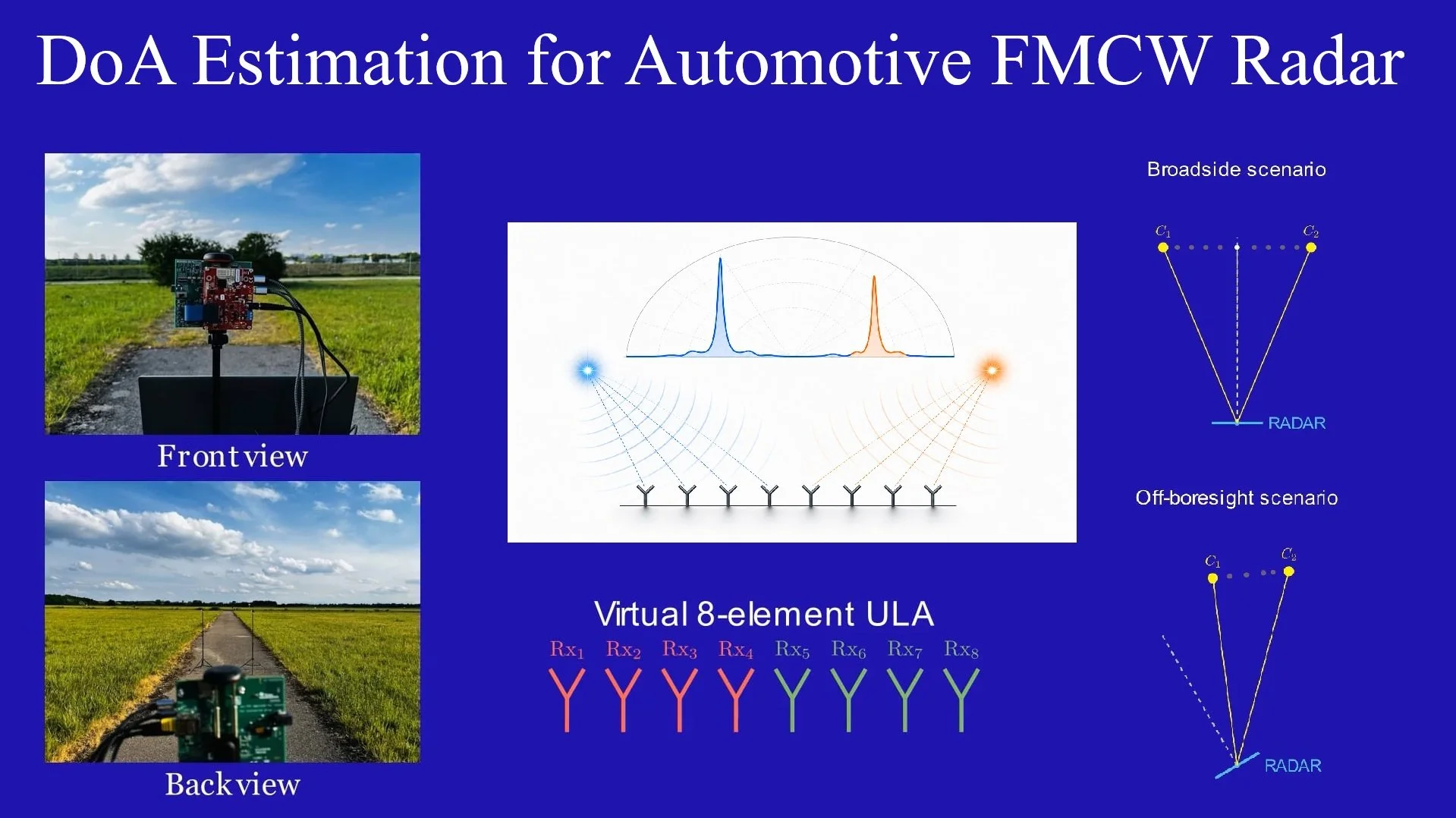
The workshop provides a structured introduction to direction-of-arrival estimation for automotive FMCW radar. The complete workflow is covered, from phased-array fundamentals and DoA theory to Python-based algorithm simulation and validation using real AWR2243 radar measurements.
A dedicated measurement dataset is included with the workshop, allowing the presented algorithms and processing stages to be reproduced and analyzed using real radar data.
The workshop covers Spatial FFT, Bartlett, Capon/MVDR, MUSIC, and ESPRIT, with practical comparison of their angular resolution, behavior, and implementation aspects.
What You'll LearnGain a clear understanding of phased arrays, spatial phase differences, steering vectors, and the principles of direction-of-arrival estimation for automotive FMCW radar.
DoA Fundamentals
Learn how DoA estimation is integrated into the FMCW TDM MIMO processing chain and applied to real AWR2243 measurements using an 8-element virtual ULA. The workshop includes a dedicated radar measurement dataset for reproducing and analyzing the presented processing and validation results.
Real Radar Processing
Learn the principles and Python implementation of Spatial FFT, Bartlett, Capon/MVDR, MUSIC, and ESPRIT, including conventional and super-resolution approaches.
DoA Estimation Algorithms
Compare DoA methods in terms of angular resolution, spectrum characteristics, estimation accuracy, and practical behavior using simulations and real single-target and two-target measurements.
Algorithm Performance
Course Structure
-
Overview of the workshop, required background, software environment, provided processing scripts, and measurement data.
-
Introduction to phased antenna arrays, spatial phase differences, steering vectors, angular resolution, and the basic principles of direction-of-arrival estimation.
-
Theory, simulation, and comparison of Spatial FFT, Bartlett, Capon/MVDR, MUSIC, and ESPRIT for conventional and super-resolution DoA estimation.
-
Measurement setup with the AWR2243 radar, including single- and two-corner-reflector scenarios in broadside and off-boresight geometries, TDM MIMO configuration, the 8-element virtual ULA, and the FMCW processing stages used before DoA estimation. The corresponding AWR2243 measurement dataset is provided with the workshop for reproducible processing and analysis.
-
Application of Spatial FFT, Bartlett, Capon/MVDR, MUSIC, and ESPRIT to the provided real AWR2243 measurement dataset, with comparison of angular spectra, target separation, and estimated directions across single-target and two-target validation scenarios.
Website Workshop
Extended Workshop
Includes the complete workshop materials with the full set of validation measurements, additional single- and two-target scenarios, broadside and off-boresight cases, processing scripts, and extended algorithm analysis.
Udemy
Light Workshop Edition
Includes the complete theory section and selected AWR2243 validation examples, with one single-target case and one two-target case. Best for learners who want the core DoA workflow in a compact course format.