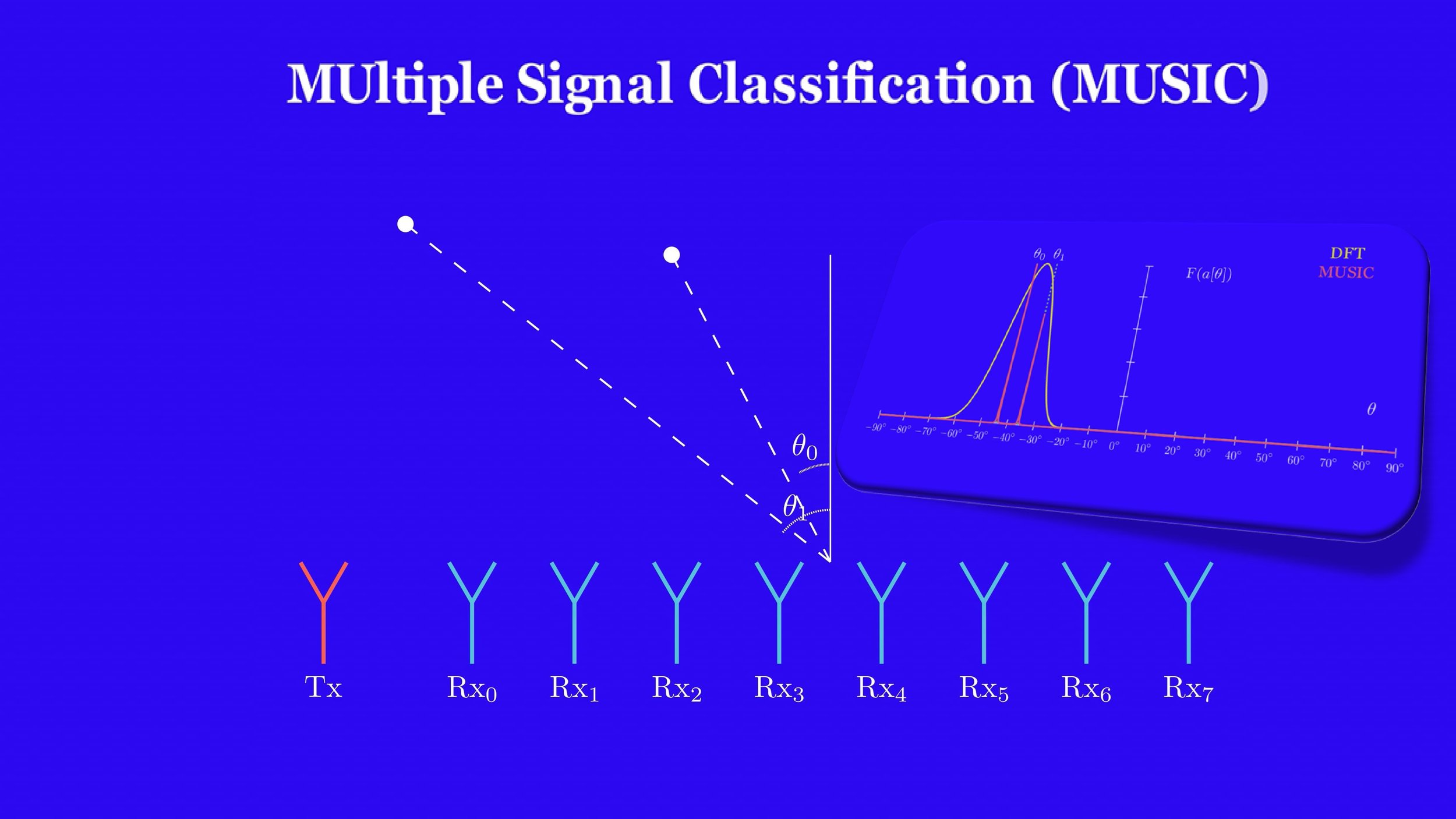
MUSIC Algorithm for DoA: Theory and FPGA Implementation
This course presents a structured introduction to the MUSIC algorithm for direction-of-arrival estimation. The complete workflow is covered, from theoretical principles and fixed-point modeling in Python to FPGA implementation and system integration using Vitis HLS.
What You'll LearnGain a clear understanding of the MUSIC algorithm and its underlying signal processing principles, including phased array operation, covariance matrix estimation, and subspace-based direction-of-arrival analysis.
Algorithm Understanding
Understand how the MUSIC algorithm is mapped to hardware using Vitis high-level synthesis and integrated as a reusable FPGA IP core.
FPGA implementation
Learn how to model and analyze fixed-point implementations, and how to evaluate precision–performance trade-offs resulting from quantization and finite word length effects.
Fixed-Point Design
Learn how the MUSIC accelerator is deployed, controlled, and validated on a Xilinx Zynq UltraScale+ platform, including software–hardware interaction and data transfer.
System integration
Course Structure
-
Introduction to phased antenna arrays, spatial sampling, steering vectors, and the basic principles of direction-of-arrival estimation.
-
Description Detailed walkthrough of the MUSIC algorithm, including covariance matrix estimation, subspace separation, and pseudospectrum computation.
-
Python-based fixed-point models of each processing stage, with analysis of quantization effects, scaling, and precision–performance trade-offs.
-
Mapping the MUSIC algorithm to hardware using Vitis HLS, including modular design, dataflow considerations, and synthesis constraints.
-
Integration of the MUSIC accelerator as an FPGA IP core, software–hardware interaction, and validation on a Xilinx Zynq UltraScale+ platform.
Website Workshop
Extended Workshop
Includes the complete workshop: MUSIC and DoA fundamentals, algorithm workflow, fixed-point modeling, FPGA implementation with Vitis HLS, and system integration on Zynq UltraScale+. Includes the implementation sources and supporting materials.
Udemy
Light Workshop Edition
Includes MUSIC and DoA fundamentals, the complete algorithm workflow, and fixed-point modeling in Python. Best for learners who want to understand, model, and validate the MUSIC algorithm before moving to hardware implementation.