ESPRIT LS FPGA IP Core
Hardware-accelerated ESPRIT LS for high-resolution Direction-of-Arrival estimation on AMD/Xilinx FPGAs.
EVALUATION
For functional evaluation and FPGA integration testing.
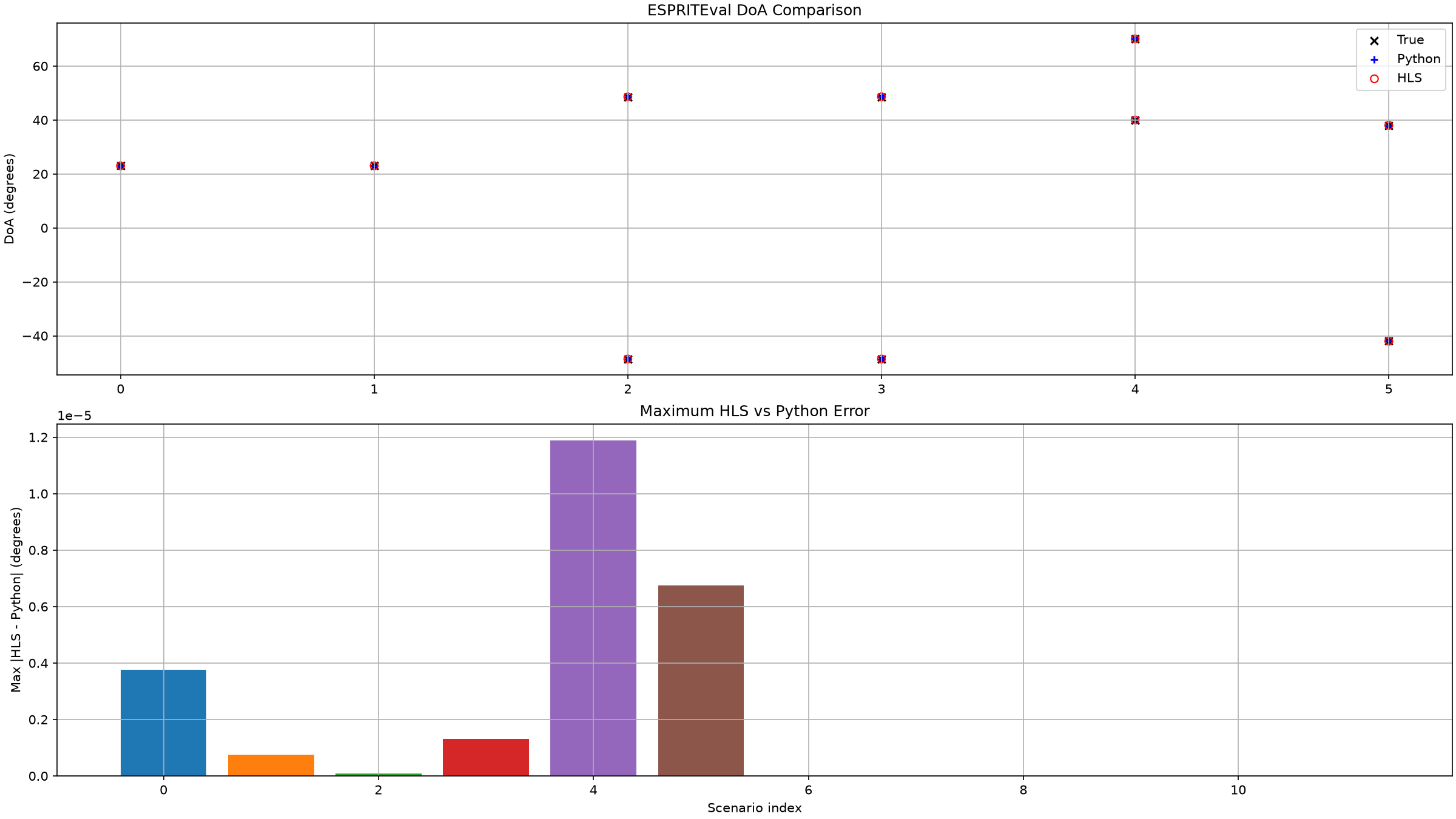
The evaluation core is verified against an independent Python floating-point reference using deterministic single- and two-source ULA scenarios with configurable per-source SNR. For each scenario, the same covariance matrix is processed by the Python ESPRIT reference and the Vitis HLS implementation.
The upper plot compares the true source angles, Python estimates, and HLS estimates across all validation scenarios.
The lower plot summarizes the numerical agreement between the HLS implementation and the Python reference using the maximum absolute DoA error per scenario. Lower values indicate closer agreement.
IP Core Features
1D ULA processing
Floating-point implementation
LS-ESPRIT direction-of-arrival estimation
Runtime-configurable 1 or 2 sources
Gridless high-resolution DoA estimation
Forward-backward averaging and unitary real-valued processing
Python API/application
C application for Linux and bare-metal
Vivado integration example
Implementation Results
XC7Z020-1CLG400C, 100 MHz target clock
DSP slices: 24 / 220 (10.9%)
LUTs: 24,721 / 53,200 (46.5%)
FFs: 13,824 / 106,400 (13.0%)
BRAM: 20 / 140 (14.3%)
Latency: 39,467 cycles (~395 µs)
Initiation Interval: 39,468 cycles (~395 µs)
PRO
A reference implementation for commercial deployment, customizable to application-specific architecture and performance requirements.
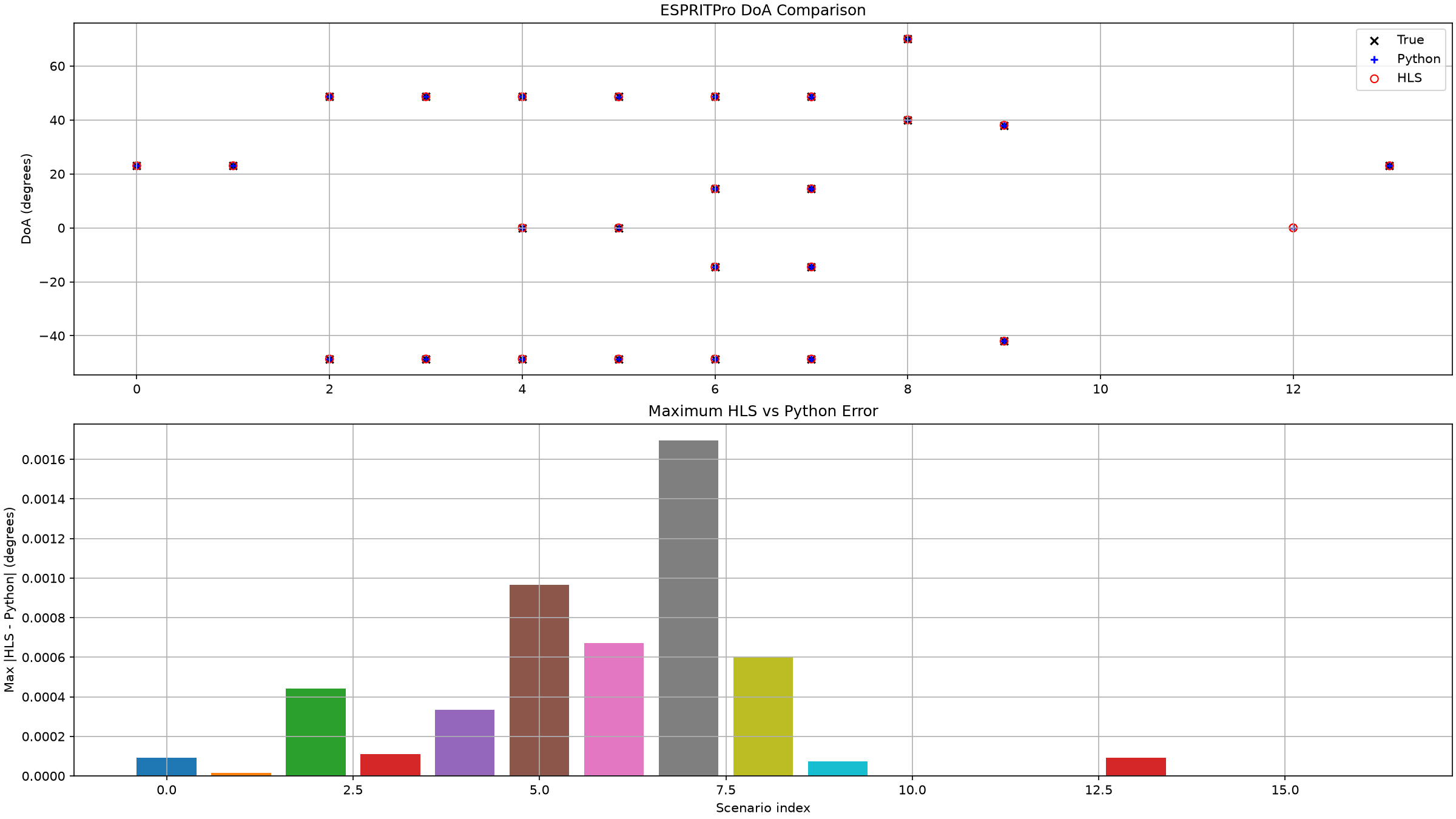
The Pro core is verified against an independent Python floating-point reference using deterministic ULA scenarios with up to four sources and configurable per-source SNR.
The upper plot compares the true source angles, Python estimates, and fixed-point HLS estimates across all validation scenarios.
The lower plot shows the maximum absolute DoA error between the HLS implementation and the Python reference for each scenario, providing a compact measure of the numerical impact of fixed-point arithmetic.
IP Core Features
1D ULA processing
Fixed-point implementation
LS-ESPRIT direction-of-arrival estimation
Runtime-configurable 1 to 4 sources
Gridless high-resolution DoA estimation
Forward-backward averaging and unitary real-valued processing
Fixed-point covariance preprocessing
IP-core runtime statistics
Python API/application
C application for Linux and bare-metal
Vivado integration example
Implementation Results
XC7Z020-1CLG400C, 100 MHz target clock
DSP slices: 75 / 220 (34.1%)
LUTs: 39,557 / 53,200 (74.4%)
FFs: 21,314 / 106,400 (20.0%)
BRAM: 12 / 140 (8.6%)
Latency: 147,169 cycles (~1.47 ms)
Initiation Interval: 147,170 cycles (~1.47 ms)